Showing posts with label feminism. Show all posts

7.14.2015

Men Explain Things To Me - a book of feminist essays by Rebecca Solnit

7.14.2015
Kindle Monthly Deal

This book found it's way on to my Amazon wishlist and sat around there until one day I decided to take a peep at the Kindle Monthly deals (expecting to find a lot of junk I wouldn't be interested in). I certainly was not expecting to find something I was very interested in reading and made a point of paying a few visits to the library in order to find. I believe for the remainder of the month you may be able to download the ebook for $3 - and I would encourage it!
I started this book on the tail end of a vacation, which doesn't mean that it set a positive mood. Yes ma'am, this book is a bummer, but it gave me a lot of introspection to do, and the issues it's covered still niggles me.

This is a collection of essays Solnit wrote over the course of the last 5 or so years, all focused on "subtle" modern feminist issues. Mansplaining being the foremost one - but generally the little things that men don't have to deal with and so have no idea are issues that exist but women deal with regularly and are expected to just buckle down and accept. Some of them seem harmless (like men condescendingly explaining things that you may actually have more expertise in) but they tend to be a symptom of a larger, far more menacing issue. Most importantly, rape. It is 2015 and I should not have to discuss in great detail on my book review blog that rape or sexual abuse is such a problem. When a woman gets raped, there's a high chance that it will be ignored by a lot of people, including the people who are supposed to help and protect her, and this is in America. It's really disheartening!
The lengths women will go to avoid something that men don't even consider are astounding. For a personal example, I have never gone out without at least one friend present. I don't mean shopping for sundries, I mean I've never been to the downtown area in the city where I live after 5pm without a companion. Either another girl or my gay guy friend who would be described as a "bear" in the gay community. Men would typically never, ever think twice about leaving their apartment around dusk and stroll through a "bad" neighborhood to get a burger or see a movie. As a woman I would have to make arrangements with someone, or if that didn't go through, stay locked and safe in my room. Because of the risk of getting raped, mugged, or murdered, even if it's statistically unlikely, I've been conditioned to believe that it's going to happen to me if I don't take precautions. Now why is that?Because regardless of what you may think, the fact is that the playing field for genders (not just in 3rd world countries, mind you) is totally unbalanced.
It was really enlightening. If I hadn't bought it on my kindle, I'd share my copy with all my friends on the school yard until when I got it back it would be tattered and care-worn. This is an important book to read for this generation of feminists!

6.27.2015

Good Girls Don't by Victoria Dahl

6.27.2015
Library eBook

I heard of this book (and it's series) after listening to the Smart Bitches Trashy Books podcast in which they discussed "Strong Female Characters" and how there's some inherent sexism in that role - something I very much agree with, think about a great deal, and am on the constant look-out for. The author Sarah is interviewing, Jaye Wells, suggested these books as an alternative to a mass-murdering, misogynist hunting warrior woman heroine. I was very curious to see my pet theory in action, so I immediately checked it out. (I'd rather not explain on this post what I believe a "strong female" should be like, but suffice to say that I find the idea in vogue to be flat-out scary. I would instead direct you to the link above where they can explain to you much better than I can, if you have an hour to spare.)

I actually was fairly impressed with the characters in this book! No one was impossibly sweet and perfect to the point where I wanted to bludgeon them over the head! This is my #1 problem in Romancelandia*. Sure, it wasn't perfect. In fact it was pretty trite, with it's cheesy dialogue (both internal and spoken) and a pretty mundane plot. But what kept it from being truly terrible is that it was realistic. Though the dialogue wasn't impressive, it was common enough. The author obviously had human interactions, which is problem #2 I typically have with Romancelandia - the fact that the author doesn't understand when it's appropriate for heroes and heroines to be angry with each other and when it isn't okay (example: romanticizing rape).

This is the first book in a series about 3 siblings who run a family brewery in Colorado. In this book, their little sister Tessa; sweet, perky, seemingly-innocent Tessa, falls for a misunderstood bad-boy detective. Her very protective brothers do not approve. But let's bring it back to the beginning (sorry, my brother is watching Parks & Rec in the next room and it's really distracting). So the brewery gets robbed early on, which is how we're introduced to Detective Luke and his Very Pregnant Partner, Simone. (Note - I love pregnant cops, they're literally my favorite things ever.) On one hand, one of Tessa's brothers (I really can't keep any of Tessa's brother's names straight - their names are very generic) f*cked up (literally) their chances of breaking into a huge business deal. So now Tessa is hard at work trying to fix the problem without letting their other brother find out.

It was entertaining. Not what I typically like to read, but it was as promised in the podcast. There was a reliably "strong female" who does what she must to get work done. She's not all "brains and beauty" who eventually proves to just be beauty with nothing else to back up the first claim. And she's strong without being frightening, and she's flawed because that happens! Women Men People are complicated and a whole mess of good and bad things! Sometimes the good can actually be bad; it depends on the situation! So story wise, it passed the time, but I wasn't enthralled. However, it gets high marks from me because it was still really well done and refreshing. Also, because it's a Romance novel, I should say that there was some nasteh goin' on, and it gets high points from me, too.


*Romancelandia - blanket term covering all of the Romance genre, including YA romance & Chick-Lit, but focusing on cheap paper backs, the kind one might find on a great aunt's bed side table, or yellowed and dusty in used book store shelves.

6.07.2015

The Waiting Years: An Impression

6.07.2015
Borrowed from J. Gossen

I don't really love coming on here and writing "reviews" for books that are technically classics. Because, I mean, who am I? I know I'm not qualified to do that. So rather, I'm writing an impression. The Waiting Years is considered a classic in Japan, which is what makes it unique to what I - as an English speaking American - would consider classic literature. So technically, it wouldn't even fall into what we call the "Western Cannon."
Lately I've been on the hunt for one of two things: proper Japanese curry and English translated Japanese fiction. Japanese restaurants in my town are a dime a dozen, but they're entirely sushi restaurants (do people not realize that they eat more than just sushi in Japan? Probably not.) and exactly one restaurant serves Japanese style curry. Alas, it's pretty expensive. And as for Japanese fiction, well I'm working on it. If anyone can recommend something written by someone other than Haruki Murakami & Kazuo Ishiguro I'd be happy to hear them. (Nothing against them, it's just that I'm certain that there are more than 2 Japanese authors out there, just as I'm certain they eat more than sushi)

The Waiting Years isn't just a Japanese classic, but a Feminist classic as well. I think the major thing I'd like to point out before I begin is that I would have benefited from reading it in a college class - though it's little it's mighty. I know there's a lot I didn't understand that I might grasp a few years from now if I ever decide to reread it. Also, I just realized a lot of people reading this are probably students, and even after I say that I'm not qualified to have any lengthy, academic discussions about this novel, there's still a good chance that someone is going to use this as help for writing a paper. Meep! I am not worthy! But all this chatter aside, I'll do my best not to let you (and your grades) down.

The Waiting Years took Fumiko Enchi eight years to write, beginning during the American occupation. This is significant because at the time, women's roles in Japan were changing radically both legally and socially. Fumiko Enchi's story is a family history taking place during a huge societal shift as Japan was in the process of modernizing.
The story, told over the course of forty years, centers around a housewife of an aristocratic man. Initially, he sends her (Tomo) out to search for a concubine for him, and she eventually brings back a quiet,15-year-old Suga under the pretense that she will act as the family's maid. Suga captures not only the heart of Yukitomo, the husband, but becomes friends with their young daughter Etsuko.
Tomo suppresses her feelings and her hurt early on. In fact, it's very rare that she ever voices her emotions. Because of Tomo's role in society, she made many sacrifices on behalf of her husband. She raises Suga as part of the family, claiming responsibility for her as if she were her own daughter. Later, Yukitomo takes on a new concubine named Yuri. Yuri and Suga become close friends. Beautifully, there isn't any of the cattiness in this household that I would have expected. But after a decade or so, Yuri leaves the house and marries, leaving Suga behind. Suga, unfortunately, will never be able to marry and have children herself because she is barren - likely due to the fact that Yukitomo took her as a lover at such a young age. A third mistress enters the scene, but this time it is genuinely scandalous as Yukitomo has a long affair with his son's wife.
While it does a great job of exploring the lives of women at the time who have little real power but emotional power, it's still very vague and short. Perhaps I'd need at least a master's in Japanese feminist literature to fully understand it. But somehow it's reminiscent of some of my favorites: Du Maurier's Rebecca, Chopin's The Awakening, The Brontë Sister's, and Grau's The House on Coliseum Street.

6.06.2015

A Darker Shade of Magic by V.E. Schwab

6.06.2015
Library Copy

Before I dive in, may I please rant a bit? It is 2015 and female writers of fantasy epics are still hiding behind gender-neutral pseudonyms to get recognition. Would A Darker Shade of Magic be the hit it is if her name would have been Victoria on the cover? Probably not, because I can almost promise that this book wouldn't even have such an evocative cover at all. This cover is absolutely what draws in many readers (It's very well designed, I have to say!) But if Victoria's name were on the cover, I'm pretty sure it would be a lot cheesier. That's just the tendency - but I'm no expert on it, so I'll end my rant here.

I was super stoked about reading this book! Yes, I was totally drawn to this fancy cover. Sometimes, like now, it doesn't lead me astray. I'd never even heard of Schwab before,
A Darker Shade of Magic is about a young man named Kell who has a unique ability in which he can traverse between, well, I guess 'dimensions.' Basically, there are four different versions of London, and because of his ability pretty much only he can go between them because Kell is an Antari. He's an Ambassador for "Red London" and travels between the other Londons - each one a snow flake - as a mediator. But he has a business on the side selling magical items to collectors that he's smuggled from the other Londons. His little hobby, as it were, accidentally gets him into a heap of trouble, in which Lila - a pick-pocket, cut-throat, cross-dresser, and aspiring pirate - helps him out of. Now the two are traveling between worlds somehow (very Doctor/Dr's Companion-esque) on an awfully big adventure.

I adored Kell from the start, but honestly I kind of hated Lila. I know, I should be supporting "Strong Female Characters" whenever I find them. But she just has zero chill. Still, I think there may be some interesting developments from her later in the series.

It was a lot of fun to read - my coworker might have had even more fun listening to my excited outbursts coming from my desk during our lunch breaks spent reading it. Though I thought this book wrapped up neatly, I am excited to see what happens in the next book on the series.

5.12.2015

Everything Leads to You by Nina Lacour

5.12.2015
Kindle


I picked up Everything Leads to You by Nina Lacour because the cover is kinda pretty, though it doesn't tell you much about what to expect from the story and neither does the title. To be perfectly honest, I went in not knowing at all what to expect.
Honestly, I was kind of underwhelmed. It started off okay, but about mid-way through I had the ending figured out, but had already invested enough into it that I'd might as well see it through.

Set in LA, Emi is a very lucky teenager indeed - though she may only be an intern, she's barely out of high school and already has her dream job: designing sets for major movies. She's an incredibly talented intern, and as such (and this is that part that's pure fiction) the paid professionals actually value her in-put. She's having a little trouble navigating her feelings for her ex-girlfriend, whom she still sees regularly at work and her brother (also in the business) leaves her and her best friend Charlotte his apartment while he's out of town on the grounds that they use it to do something epic.
Charlotte and Emi visit an estate sale for a famous bachelor and discover a letter meant for his unknown daughter, but instead it leads them to a troubled girl by named Ava.

Okay, here's what I did like about this book:

  1. Lesbian heroine - LGBT themes in YA has come a long way since I was a teenager (which wasn't such a long time ago) and I think that's so wonderful and healthy, but I still wish there was more of it!
  2. Realistic (sort of) portrayal of what it's like to be a young professional. You can do your best, in other words, and still be stunned by how naive and inexperienced you still are. That part felt really true.
Here's what I didn't like:
  1. Some of it felt flat. Like, I didn't feel the attraction to Ava - Emi seems like the sort of girl who will just about fall for anyone. Even though as a straight woman (so please take this with a grain of salt), I felt no chemistry for Ava, though it was totally predictable that they would end up together.
  2. Sigh. Okay. I get it. Emi is a decorating prodigy. And while I actually thought her working was one of the more interesting parts of the book, I don't actually care about her spending a large sum of money on framed prints. More specifically, I don't like that there was so much significance placed on some framed prints (or the green couch), only for them to just vanish from the plot.
I'm in the minority, but I thought it was just 'ight. I can promise that a year from now I will have no memory of ever having read this book at all.

1.23.2015

Spinning Straw Into Gold

1.23.2015
Amazon Used
This week caught me off my guard - I simply couldn't escape some unpleasant surprises. So here I am, my jaw sore from a surprise dentist visit, feasting on ice cream, mashed potatoes, and Ensure. I would admit to be miserable, but this is just the sort of thing I actually like because it means I get to catch up on my reading while I should be working. I personally believe that life has a way of throwing you off your daily rhythms when you're in need of a break that you might be just too stubborn to pause for. Such was the case this time!
I happened to find this book - lost or discorded, whichever the case, but momentarily forgotten - with only a few pages left unread.
I picked this book up as research for a personal project, which I've already reviewed a few other books for. This one was, after having read the others, more of a review on things I already knew by now. However, even though it mostly agreed with everything I've already studied about fairy tales, it also managed to have something fresh and original to say as well. If you're moderately interested in learning about reading between the lines of fairy tales, this is one of the books I would send you to (as well as Women Who Run With Wolves - though both of these might be considered "feminist" and might not be of a particular interest to male readers per say.) Like in the other books I've read, Joan Gould uses fairy tales to map out the particular crossroads women spanning all ages might meet in their lives, and explains what they might mean to you. Once again, it's interesting to me how fairy tales can be older than the hills but still be totally relevant to modern women. More so if you look a little closer than at face value.
The gimmick of the book is that it asks you "what is your favorite fairy tale?" and then it goes on to explain why it - and other, similar stories that aren't necessarily fairy tales (Jane Eyre, Pretty Woman, etc...) - might be significant to you. Once again, this is primarily focused on female readers.
It was very interesting, and I would love to share it with almost all of my lady friends, but I doubt they would have as much an interest in it as I had - they might have some arguments to make about it. But to me, it seems wholly sound.

1.19.2015

The Finishing School Series

1.19.2015

Have you been wondering where I've been, dear readers? Wonder no more. This Christmas season I received from my bestie the entire (at press date) Finishing School series by Gail Carriger (of Parasol Protectorate fame) - and under peer pressure I read the entire thing (as quickly as my work schedule allowed). I debated on reviewing them each individually, but because I moved on from one to the next so quickly I didn't give myself time. Instead, I'm just going to review it as a whole - as I have the rare opportunity to.

Christmas Gifts from Jenee G.
Looking back at my reviews of the Parasol Protectorate books I'm a little horrified to see that I didn't love them as much as I remembered enjoying them. I guess the two feelings can mutually exclusive? I think of that series as a prototype for this one, however. I feel like Gail toyed around with some of the same ideas that she brought back in these books - and now honed them to perfection.

The Finishing School series is basically about a Victorian girls charm school, which sounds so quaint doesn't it? Well, they're also training to become assassins and spies. Picture it! Using handkerchiefs and sewing scissors for lethal weapons? Sounds pretty perfect to me. It has a beautifully droll sense of humor, which is more than enough to hook me, a series of badass girls and "evil genius" boys, foppish vampires, genteel werewolves, eccentric professors, cross-dressing, and a few more of my favorite things.
I absolutely don't want to give too much away, so at this point I just want to talk about my impressions. There aren't many characters in this series, which is fine (because once you read something like Game of Thrones you start to appreciate that) but one thing that I didn't like is that the minor characters didn't get a whole lot of chances to develop sooner. This series is going to be 4 books long and so far we have three, so that is something that stresses me out a bit. Naturally, the important characters do by the 3rd book, so that's what's important. Hopefully Carriger revisits some of them in later books. Failing that, this is ripe territory for fanfic writers - which I very much encourage. Part of the reason for this review is that this series has a very small fandom and that, to me, is so ridiculous. Please read this books and make lots of fanart and fanfics, everyone! Make all of the things, make it blow up. I want all the movies, video games, a TV series - I want this thing to never die, ya heard?
This series shares the same world (and sprinkling of some of the same characters) as the Parasol Protectorate books, but dated a few decades earlier. Like in Protectorate a lot of the names are nearly unpronounceable - something my friends and I have been debating back and fourth on. However, one of the beautiful things about Carriger's steam-punk world is that it isn't idealized and floofy like some proto-Victorian writers. One of the reasons I've been obsessed with the Victorians for most of my life is that they weren't always as genteel as we now seem to think. They were actually kind of horrifying sometimes. They may have been sexually repressed, but they compensated for it through other avenues - like a healthy obsession with what we today would consider outright macabre. These books don't include examples of this, at least nothing that high school librarians would picket against, but Carriger is aware of it. These books are anything but cutesy-poo.
Ah, now for the "shipping-wars." I'll reveal nothing of my own alignment on here, but you'll be tempted to pick sides and let me just say neither are bad choices. I made it very well known that I wasn't going to share my ships with my friends (because I didn't have one, really. It could go either way for me.) but the 3rd book ends in such a way, that... ugh... #1 whoever you choose, you'll be conflicted no matter what and #2 the 4th book isn't coming out until next November. All this tension and unresolved feelings has me like:
(too late)
Thankfully, Gail will be releasing a new book for a new series this March which I can't fuggin wait for. Maybe that will tide me over until then.

9.22.2014

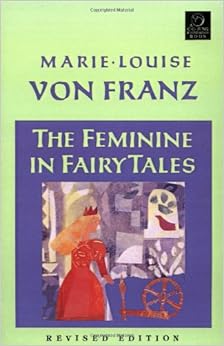
The Feminine in Fairy Tales

9.22.2014
Amazon Used
This isn't going to seem like a very interesting book, but I have to talk about it once I've finished it. As I've read this book in it's entirety as research for a personal project, it's not going to be much of a "review."

I would consider this book as more of an expansion of the materials you read about in Women Who Run With Wolves. I'm becoming quite the expert on particular stories and motifs (I joke that someone should just hand over my PhD any time they're ready - but we can talk about that when I scare up some grad school money maybe/eventually/never).
It does relay a lot of the same information that Women Who Run With Wolves covered, but examines it in closer and more academically, under a Jungian lens. Where Women Who Run With Wolves played more at women readers' sentiments, The Feminine in Fairy Tales asked you to examine yourself and others. Or rather, taught you how to. This wasn't a self-help book at all: it was philosophical and exploratory, but it focused more on the meanings behind the actions of common and uncommon fairy tales - not the reader. Still, it had gave me a lot to think about, personally, which is just a side effect.
It was fascinating, but not for the masses. For that, go to Women Who Run With Wolves. If, perhaps, you have a school paper to write - this makes excellent research. It can be bought on Amazon, but a quick Google search might scare up a PDF version, if you're a poor college student looking for some help.

5.09.2014

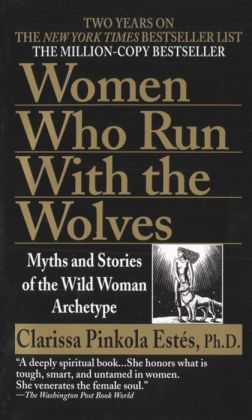
Women Who Run With The Wolves

5.09.2014
Amazon Used ($4 total)
An interesting thing happened while I was reading this particular book, which has been strongly recommended to me from various sources and bought for one cent (used) on Amazon (with shipping - $4 exactly). Though some women have expressed interest in it, men have definitely given me different reactions - for the most part very condescending reactions. Hopefully, my review will explain why that is a really unnecessary and ridiculous reaction. It is worth noting that while reading this book, it got a lot of negative attention - more so than when I read basically anything else. I got less negative attention while reading smarmy Christian romance novels. At least four different people have given it a quick glance and automatic disdain. Anyway, I don't expect this to be my most popular review.

So you should check your expectations at the door. While I can understand why some people would find the title off-putting, I'm still surprised by those strong reactions. Even more so because I know that those expectations are completely unfounded. If you are expecting this book to be a furious bohemian feminist manifesto or "self-help," you are absolutely wrong. The sub-title says it all - "Myths and Stories of the Wild Woman Archetype" - as in, Jungian Archetypes in Mythologies and Folktales Explained to YOU, Dear Reader. So yes, maybe that is a form of "self-help." "Wild Woman" really just means, "every female that doesn't fall into the same category as the virgin mother," in other words, every daughter, sister, mother, friend, lover who isn't pure and perfect. And that's basically all of us, no matter what.
It's academic, wise, and non-critical. While I started off reading it alongside The Heroine's Journey, I found that this book was more informative, fair, relaxed, and pleasant as a whole than the other book was. It's a good way to discover lesser known folktales and myths, if you're interested in that (which I completely am). It's wonderful if you want the common nuances and motifs in those sorts of stories explained, though remember that that means it's focused on feminine motifs.
It's also so inspiring! If anything, it was a great reminder and coach that in my own life, I should use these stories as guides for any season I find might find myself in - be it illness, grief, motivation, romance, family, career, whatever! It's almost as good as therapy and, uh, so much cheaper. I know I'm going to continue to revisit this book over and over, and I'd like to recommend it to all of the women that I know - provided that they're receptive to it.

4.24.2014

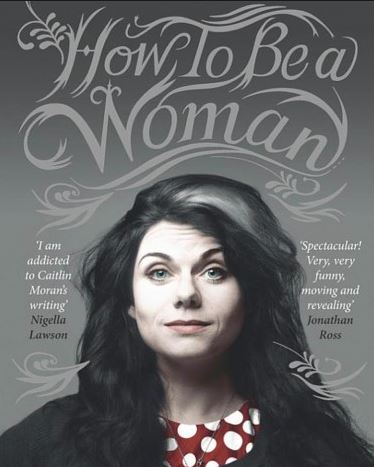
How to be a Woman

4.24.2014
Kindle App
If You're one of my friends who thought that they beat me to the bookstore and tried to recommend Tina Fey's Bossypants to me 3 years after I read it (you're cute; nice try) then allow me to counter back with a recommendation of my own.
How to Be A Woman is an entertaining, easily digestible break-down of the pitfalls of being a modern woman. This is no academic, silk-handkerchief skirted, henna haired feminism. If that's your brand of feminism, then this book will not be for you. Who this book is for - and I feel like a jackass for even thinking it - any woman who strongly self-identified with Bridget Jones. In other words, if you are a woman who feels at all self-deprecating about all the little girl things - from purses and designer shoes to family in all it's fucked-uppedness - and consider themselves a feminist, you'll probably enjoy this book. Not that this is a totally original concept. How many of these essayist memoirs have I read about the trials and tribulations of being a Thoroughly Modern Millie? From Tina Fey, Mindy Kaling, Nora Ephron, and Lord Knows how many Sassy Southern Ladies - the field is well trodden.
So what makes this one special? While I really love this sub-genre - it does a great job of making me snicker and punch at the air - the target audience is usually women. Real Talk for Girls. Gents will only feel put out. But God Bless Caitlin Moran, for she doesn't skewer men. Patriarchy? A little. But she's not a man-hating feminist. I really think there are tons of men in my immediate and extended social circles who would enjoy this more than some of my lady friends. All I have to say is "if you liked Bossypants, you'll Love How to Be a Woman."

3.30.2014

The Heroine's Journey: A Woman's Quest for Wholeness

3.30.2014
So, first I have to apologize for my 2 month absence. To quote God Help the Girl: "I've got to save some dough - I'm a working girl, you know." My day job hasn't been awarding me with much extra time for reading and writing. All the same, I've been struggling to make time to work on a personal project which will involve a lot of research before I can even get started on it.
That project is why I've taken some time away from reading fiction almost entirely and plunged headlong into non-fiction. Hence, I bring you a quick and dirty review on Maureen Murdock's The Heroine's Journey. This book was published in 1990, and I feel like that's important to mention because some of it's theories are - as I feel - dated. What I thought I was picking up when I got this book was a breakdown on a strong female character archetype (which would be immensely useful for the project I have planned). While I did glean some of that from this book, it was more of an old-fashioned Feminist Psychoanalyst? If that is even enough to encapsulate it. Regardless, I was half impressed and half disgusted with what I found. There were parts - the psychology - that I considered completely dead on. Very accurate; it hit really close to home. There were other parts - the feminism - that kind of made me disgusted. Yes, I am a feminist. But I'm a millennial feminist, which means that the modern definition of feminism has had 20 years to evolve from the feminism in this book. For the better, personally. In 1990, right on the cusp of the mid-90's "Girl Power!" phase of feminism, men where still considered something to beat back with a broom handle - at all costs. Women were still divorcing their husbands on the grounds that They Were Men, And We Don't Need Men. I believe the millennial feminist has more respect for men, as many more millennial men have more respect for women - and as it turned out that was half the battle. We are focusing more of our attention on gaining respect for everyone. So it's entirely cringe-worthy to still see what I consider middle-aged, Crazy Liberal Mama Feminism is an actual thing, though it helps to remember this book as a relic.
But there was still some nice things that it made me think about and realize - it isn't all flawed. For instance, as the heroine in our own stories, we get the idea that to be "strong" we must swing strongly in the opposite direction - we must be more masculine than feminine. That's the danger, Murdock says. We aren't built to be compatible with the traditional idea of a manly "strength." This isn't saying we can't be strong women, or that we shouldn't try to be strong women - but do so in such a way that you don't lose sight of your own femininity - whatever that means for you.

Thoughts by Feast of Poetry & Drink of Prose. All rights reserved.
Blog design by Labina Kirby.