Showing posts with label weeaboo. Show all posts

8.05.2015

SuperMutant Magic Academy: A Graphic Novel by Jillian Tamaki

8.05.2015
Library Copy

It's been long enough since I've written about a graphic novel, and that's not because I haven't been reading them - I absolutely have. It's just challenging to write reviews for individual TP's, so I avoid doing it. But when a graphic novel is a stand-alone thing, that makes my job easier.

Jillian Tamaki is probably best known as the illustrator of the now mandatory Summer Reading assignment for some very lucky middle-school kids - This One Summer. I'd remarked in that review of how jealous I was of her ability to draw such fluid characters and stunning landscapes. SuperMutant Magic Academy was a web-comic Tamaki made, and I have to say I kind of enjoyed seeing her art improve over the course of the series.
Each comic is brief but snarky, dark, and bitingly honest. You get a good idea of Tamaki's sense of humor, but it's a good description of the modern teen & young adult. Sure, it's set in a high-school almost Hogwarts-esque or like Professor Xavier's School for Gifted Youngsters, but there's no acknowledgement that this school is especially special or woo-woo or anything like that. The students are all still teen-aged dirt-bags, and that's kinda refreshing.

I enjoyed this collection of comics, having read a few online over the years but never kept up with the web series as a whole, it's nice to be given the chance to read them all at once like this. It's also really refreshing to see talented illustrators I know from a web presence break into the publishing industry. (I mean, publishers would really have to be foolish to completely ignore that amount of popularity. That's what we like to call "leaving money on the table.") Now, what comic book will I read next time I'm waiting for my friends to meet me for coffee on Sunday mornings?

6.07.2015

The Waiting Years: An Impression

6.07.2015
Borrowed from J. Gossen

I don't really love coming on here and writing "reviews" for books that are technically classics. Because, I mean, who am I? I know I'm not qualified to do that. So rather, I'm writing an impression. The Waiting Years is considered a classic in Japan, which is what makes it unique to what I - as an English speaking American - would consider classic literature. So technically, it wouldn't even fall into what we call the "Western Cannon."
Lately I've been on the hunt for one of two things: proper Japanese curry and English translated Japanese fiction. Japanese restaurants in my town are a dime a dozen, but they're entirely sushi restaurants (do people not realize that they eat more than just sushi in Japan? Probably not.) and exactly one restaurant serves Japanese style curry. Alas, it's pretty expensive. And as for Japanese fiction, well I'm working on it. If anyone can recommend something written by someone other than Haruki Murakami & Kazuo Ishiguro I'd be happy to hear them. (Nothing against them, it's just that I'm certain that there are more than 2 Japanese authors out there, just as I'm certain they eat more than sushi)

The Waiting Years isn't just a Japanese classic, but a Feminist classic as well. I think the major thing I'd like to point out before I begin is that I would have benefited from reading it in a college class - though it's little it's mighty. I know there's a lot I didn't understand that I might grasp a few years from now if I ever decide to reread it. Also, I just realized a lot of people reading this are probably students, and even after I say that I'm not qualified to have any lengthy, academic discussions about this novel, there's still a good chance that someone is going to use this as help for writing a paper. Meep! I am not worthy! But all this chatter aside, I'll do my best not to let you (and your grades) down.

The Waiting Years took Fumiko Enchi eight years to write, beginning during the American occupation. This is significant because at the time, women's roles in Japan were changing radically both legally and socially. Fumiko Enchi's story is a family history taking place during a huge societal shift as Japan was in the process of modernizing.
The story, told over the course of forty years, centers around a housewife of an aristocratic man. Initially, he sends her (Tomo) out to search for a concubine for him, and she eventually brings back a quiet,15-year-old Suga under the pretense that she will act as the family's maid. Suga captures not only the heart of Yukitomo, the husband, but becomes friends with their young daughter Etsuko.
Tomo suppresses her feelings and her hurt early on. In fact, it's very rare that she ever voices her emotions. Because of Tomo's role in society, she made many sacrifices on behalf of her husband. She raises Suga as part of the family, claiming responsibility for her as if she were her own daughter. Later, Yukitomo takes on a new concubine named Yuri. Yuri and Suga become close friends. Beautifully, there isn't any of the cattiness in this household that I would have expected. But after a decade or so, Yuri leaves the house and marries, leaving Suga behind. Suga, unfortunately, will never be able to marry and have children herself because she is barren - likely due to the fact that Yukitomo took her as a lover at such a young age. A third mistress enters the scene, but this time it is genuinely scandalous as Yukitomo has a long affair with his son's wife.
While it does a great job of exploring the lives of women at the time who have little real power but emotional power, it's still very vague and short. Perhaps I'd need at least a master's in Japanese feminist literature to fully understand it. But somehow it's reminiscent of some of my favorites: Du Maurier's Rebecca, Chopin's The Awakening, The Brontë Sister's, and Grau's The House on Coliseum Street.

10.06.2014

Uzumaki

10.06.2014
Amazon Used
I was actually really excited to read this graphic novel. I've been seeking it out since it first dropped in America around 2002. I know - 12 years seems like a long time to wait to read a comic book, but understand that the nature of manga in the early aughts was that it was an expensive hobby for a teenager. Finally, the stars aligned and I was able to find it as an omnibus for a great price - also, I'm an adult with a job and I can actually afford that kind of hobby.

So, we've already talked about how difficult it is for horror stories to scare me. I'm not much of a sucker for the genre - in fact most attempts to scare me, I can't take seriously. It's a rare novel that will actually get under my skin, so to speak. Uzumaki did that. Because a lot of themes in horror are actually absurd, sometimes the line between stupid and scary can be easy to cross. But count on the Japanese to remove the line entirely. I mean, it's a combination of stupid and scary. There's no picking sides, there's no side to pick. And full disclosure, I don't mean "so stupid it's scary," like, you know, real life can sometimes be. I mean, the Japanese are so completely "odd-ball" by our Western standards that a lot of what is actually really scary about this manga could also be just complete weirdness.

This was weird at times, but I got the feeling that Junji Ito started off with this one crazy idea - for a man to become obsessed with the swirl pattern to the point of grotesqueness (he kills himself by forcing his body to become a swirl) - and had to apply swirls and spirals into the ongoing comic in whatever creative way he could manage. Mangaka are on such a demanding work schedule, they aren't ever given a lot of time to plan out their ideas, so sometimes the stories seem forced and don't work out very well, and sometimes they're really successful. This isn't dissimilar to the way Stephen King (in particular) works, actually.
Because this was a complete collection of the series, there were a few subtle details you notice when looking at the work as a whole instead of having collected the series book by book. For instance, early on, the series starts slow, but steady. Our heroine, Kirie, watches as her boyfriend's family is driven insane by any natural occurrence of spirals. When he loses both parents, natural spirals steadily begin effecting other people. Curls in your hair, snails, metal springs, ect. - all these become unlikely, yet all the more horrifying, killers. Though it's clear that when Junji Ito had his ending in sight, he knew exactly what he wanted to do with it. On a whole, it became creepier and creepier as the series progressed. It may be *gasp* my new favorite horror book!

Besides the story, it also had beautiful illustrations - in manga, it's unusual to see characters that are actually distinctive in ways besides haircuts and gender (sometimes, not even that!). But that wasn't the case here. Also, Kirie is one of those great feminist characters you don't get to see much in comic books. She's girly and loyal - in fact, her loyalty is her real strength. I disagree that feminist heroes can't have love, and must be bombastic. They can be, you know, regular, realistic girls too! They can be pretty, but don't have to be sexy. Kirie is all that!

Uzumaki might be my new favorite horror!!

9.09.2014

Adventure Time with Fionna & Cake: Double Feature

9.09.2014
There are times when you need something fun and frivolous to read. Sometimes you need to give the ole' think-gut a rest, you know what I mean? I'd spent the last few weeks investing a lot of time reading a certain 800+ paged novel, only to have a it spoiled by a jerk friend. (There are some spoilers that just happen, and it can be forgiven. But this was a particularly asshole way to do it.) I'm pretty angry about it - I was just innocently reading and enjoying my book when this happens, and before you ask, no it wasn't Game of Thrones related. So I had to put it away (instead of just sitting around waiting for the axe to drop) and read something else to get my mind off of things.
Local Comic Store
Amazon Smile
So I opted to read some spin-offs of a cartoon franchise I really enjoy.
Even as a kid, I wasn't a fan of licensed books or series' that had too many sequels. I especially didn't trust books without a real author, feeling as if they were somehow illegitimate. But if they were part of a franchise I liked enough, I would want to give that franchise all of my money. Such is the way with Adventure Time's Fionna and Cake. I have been a fan of them since Natasha Allegri first posted her cute and very accurate comic strips on her Tumblr. I sure hope she's getting royalties from these spin-offs or something, because I'm going to continue buying anything Fionna and Cake related as long as they keep making them. Mainly on the grounds that actual episodes featuring them on the Adventure Time cartoon are rare, but also because I believe in supporting things that I think are awesome.

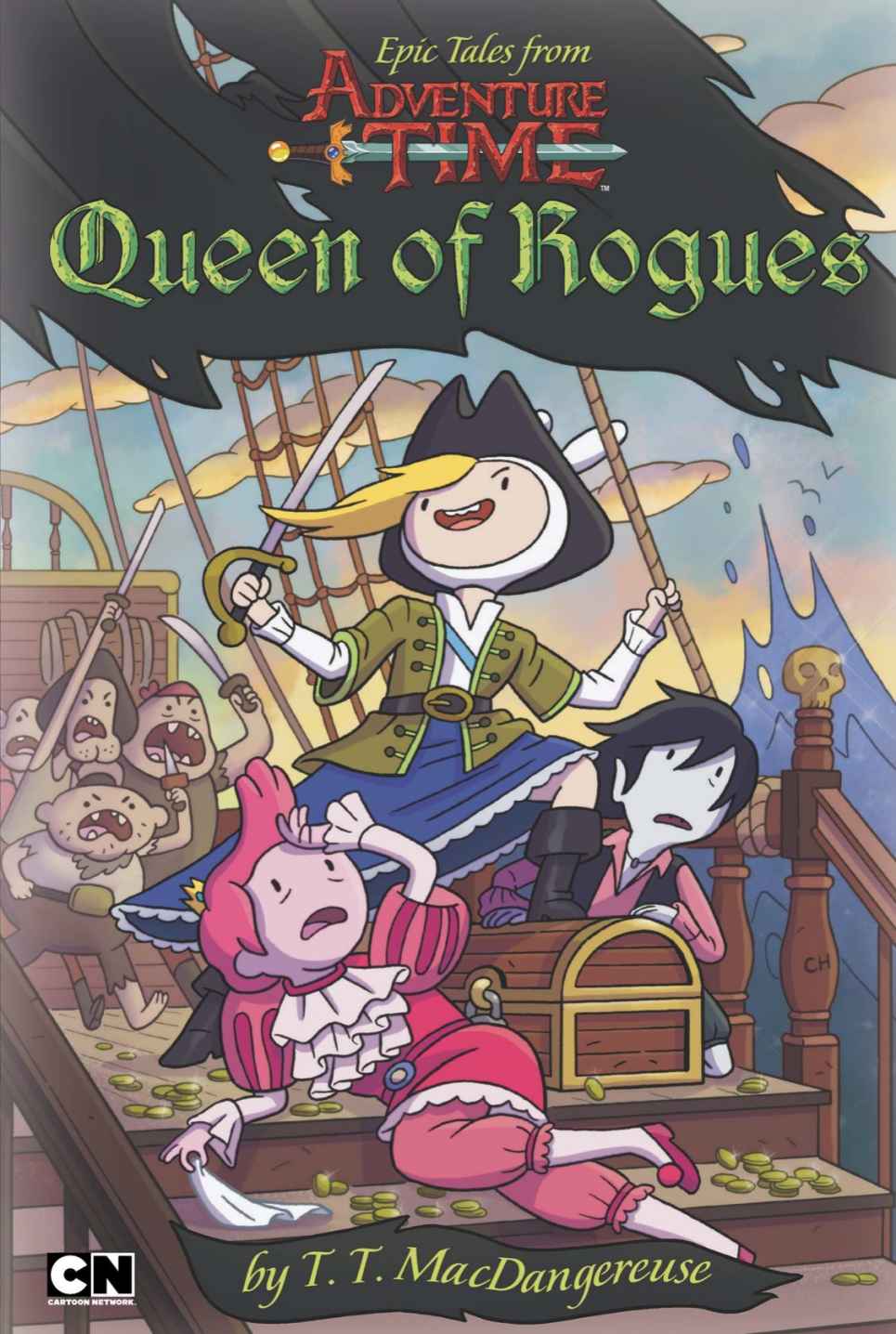
So, I read both the comic (at press time, there is only one volume - I don't know if there will be any more in the future) and a children's novella called "Queen of Rogues" - which was advertised as a romance novel, but there wasn't any romance to speak of.
First, the comic book. As it was helmed by Natasha herself (she did some writing and illustrating) it felt the most legitimate. At least, you get a more authentic feel of her original Fionna and Cake characters, which early on didn't seem like gender bent versions of Finn and Jake, but were their own things. Fionna and Cake are heavily influenced in both art and story by Japanese Shojo manga, which feels very natural with Natasha's art and story telling, as well as with the other artists and writers who wrote and illustrated for this comic.
The only issue I had was that the story telling was that it was a little too light, whimsical, and simplistic. (It started off brilliantly with the Flame Queen.) I remembered the original strips were really funny, though they might have been a little inappropriate too. I think the publishers were too afraid to go as dark as Cake leaving dead mice in Fionna's bed - maybe because that might be too intense for their little girl audiences. (I don't know, at that age I'd seen my cats do plenty of f**ked up things and I still like cats just fine.) I hope we do get further issues so that we can see more of Natasha's cutesy but still very wicked wit shine through.

Now for Queen of Rouge's - an obviously ghost-written franchise novella for younger readers. Actually, it was really well written and interesting. It was released with another book starring Jake the Dog and Lady Rainicorn, which was really romancey, but from what I saw of it, really stupid. This story was supposed to tell some of the background of how Fionna and Cake were introduced to Prince Bubblegum and Marshall Lee the Vampire King. I seriously doubt that any of it is cannon, but try convincing your kids that. I can see both young boys and girls enjoying this book, if you're a parent having a hard time getting your children to enjoy books.

12.09.2013

A Tale For The Time Being

12.09.2013
You might remember earlier this year this book being on my wish-list. It wasn't long after I'd posted about wanting it that I decided to just buy it anyway. I would have read it right away if my reading list hadn't gotten interrupted so often. But here we finally are!
A Tale For The Time Being doesn't mean "A Story For Right Now" but rather "A Story About A Being That Exists In A Plain of Time." For instance, we are time beings. Our pets are time beings. Our houses and cars and clothes and food, the trees, mountains, rivers, cities, etc - all of these things are time beings. That may seem really weird and trippy to some people, but this book is heavily influenced by Buddhism and philosophy - and when I say that suddenly it starts making a little more sense, doesn't it?

A Tale For The Time Being is about an author named Ruth who lives on the Pacific Coast of Canada, and while out strolling along the beach one day, comes across a plastic bag filled with family mementos and the private diary of a troubled Japanese school girl, presumably from the 2011 Tsunami. Ruth becomes entranced by Nao's stories of being bullied, her suicidal father, Nao's grandmother who is a Buddhist nun, and Nao's great uncle (a WW2 kamikaze pilot) and further delays writing her own book to find out how Nao's story ends.

This novel was very complicated and intelligent. I've always been obsessed with Japanese culture, but I'm always learning more and more about it. This novel shed a fresh light on a lot of what I thought I knew: I wrote a lot of personal notes while reading it - it changed my perspective on Japan, suicide, reading, writing, etc. That's what a good book will do - change the way you think. All the same, I don't think this book will stick out in my memory in any definitive way. I wasn't disappointed with it - that's not what I mean. It's very smart, and it had the potential to wind up being very "weird," but it didn't go there, and I'm pretty grateful for that. But I know if someone were to ask me 6 months from now what I thought of it, I doubt I could give them anything but the vaguest (even vaguer than this) of answers.
Thoughts by Feast of Poetry & Drink of Prose. All rights reserved.
Blog design by Labina Kirby.